
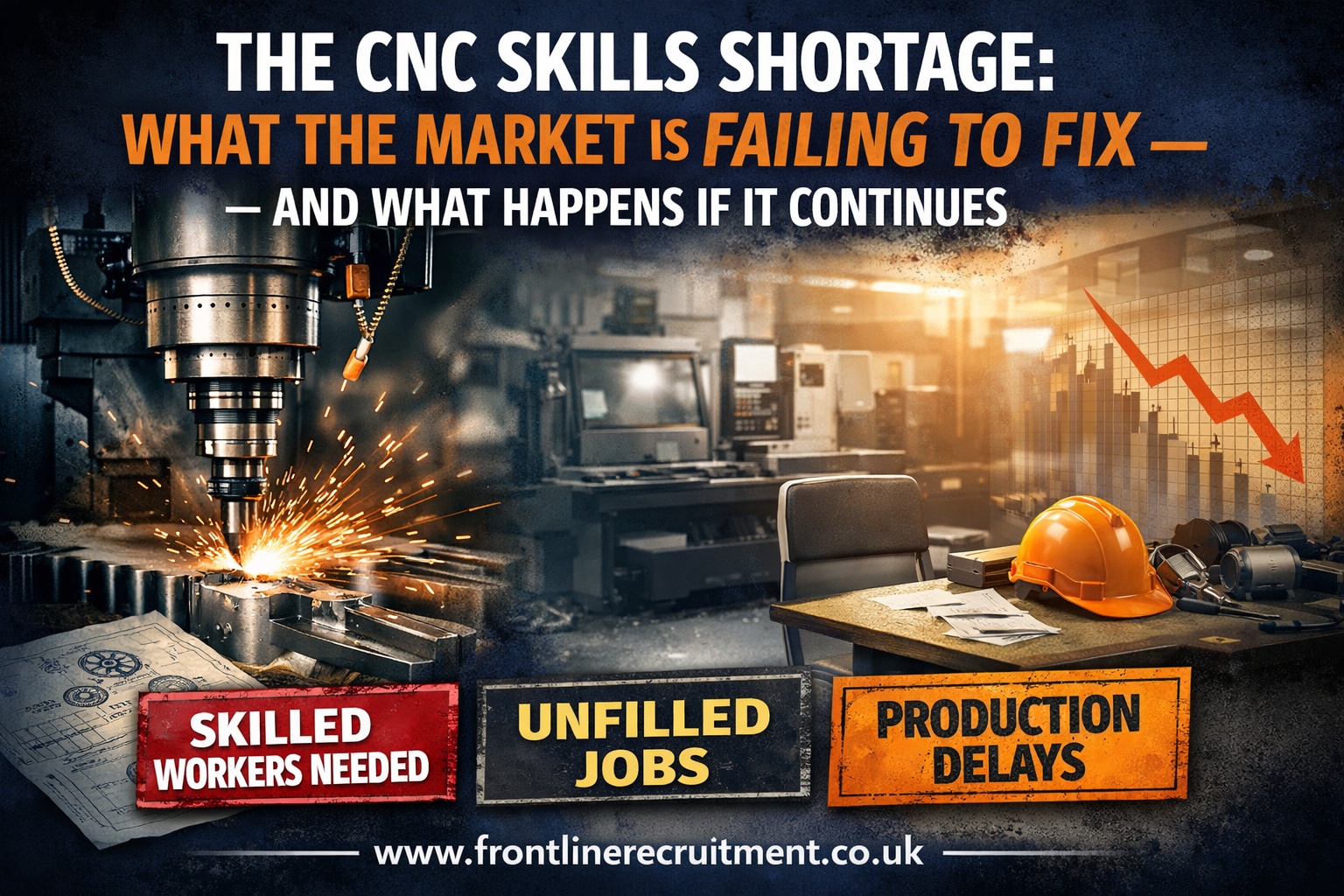
Market Insight: The CNC Skills Shortage
The CNC Skills Shortage: What the Market Is Failing to Fix – and What Happens If
It Continues
Across the UK CNC OEM and automation sector, companies are attempting to solve tomorrow’s engineering challenges using yesterday’s hiring methods. Service engineers, controls engineers, applications specialists, and automation professionals are becoming increasingly difficult to source, yet recruitment processes remain slow, reactive, and under-prioritised. This is no longer a recruitment
problem. It is a commercial risk.
Why the Market Is Failing to Find Skills
The skilled CNC talent pool is not growing at the same pace as demand. Apprenticeships take years to produce high-level engineers and many experienced professionals are being recycled between employers rather than newly created. Competition is intensifying, hiring processes are too slow, and unrealistic job expectations continue to narrow candidate availability.
What Happens If This Continues
OEMs will face longer machine downtime, lost revenue, delayed projects, burnout of existing staff, and increasing dependency on contractors. These issues directly impact customer satisfaction, brand reputation, and long-term competitiveness.
The Market Needs to Change
Hiring must become a structured business process rather than a reactive activity. High-impact roles need controlled search strategies, faster decision-making, and proper investment. The market must move from hoping candidates apply to actively securing the talent required to protect operations.
The Real Risk
The greatest cost is not paying more for engineers. The greatest cost is not having them at all. Machines do not generate value without skilled people behind them. If hiring remains unstructured, the CNC skills gap will not close – it will widen.
How OEMs Can Start Fixing It
The skills shortage will not be solved by posting more adverts. It requires a shift in how critical engineering hires are approached. OEMs that are consistently successful are doing three things differently: 1. They treat key engineering hires as business projects, not admin tasks. Urgency, budget, and ownership are defined from day one. The role is managed like any other operational risk.
2. They move faster. Interview stages are reduced. Decisions are made in days, not weeks. Speed now directly equals hiring success. 3. They invest in control, not chance. Rather than hoping the right person applies, they use structured search and proactive headhunting. This is why priority and retained hiring models are becoming more common in CNC OEM recruitment.
The companies that adapt will secure the talent first. Those that don’t will compete for what remains.
For further information please contact:
Ross Barnett
CNC & Automation Specialist Recruiter
Over 10 years specialising in CNC Service & Applications Engineers
Email: rossbarnett@frontlinerecruitment.co.uk
Mobile: 07852 640582